Or, the more things change, the more they stay the same
Today was Day 06 of Eve Horne’s PMM Jam. As you may or may not recall, one of the theses of the event, right on its web page, says “…the underlying PMM skills that hold their value no matter which tools come and go, and the adaptability to keep steering as the landscape shifts.”
Sushmita Banda presented and led a discussion about the intellectual and literal pause you should take to execute deep human thought about problems and process before ever building anything that uses AI.
Two important reflections from me about her session:
First, let’s concede that Sushmita’s discussion about Product Marketing skills and AI can apply to product management skills, business skills, communication skills, project management skills, customer discussion skills… Heck, everything a “full stack” PMM should have.
The session was filled with words like “journey,” “intake,” “RFP,” “Subject Matter Expert,” “Legal and Compliance,” “Launch Priorities,” “Persona,” and many more that are part of what PMM pros, and the titles that came before, have always used.
2. Second, Sushmita’s thesis seems to be “what I really want you to take away from this is the thinking that happens before you put in your first prompt.” Could we not have expanded the timeframe of the modern tech era (or frankly, even earlier) and recast this sentence as “What I really want you to take away from this is the thinking that happens before you {Phrase X}” where Phrase X could be:
- Write the MRD
- Write the spec
- Create the PRD
- Work on your Epics
- Manage the backlog
- Engage in a customer call
- Brief the press
- Pitch an investor
- Write a press release
- Come up with a message house
- Etc…
(EDIT: Yes, I know that this list contains old-school words. That was my point…)
In other words, what this session pointed out (at least to me) is that if we take AI out of the equation, the kind of “pause” and “have a think” this whole discussion is about should take place every time a quality business task is planned and executed, regardless of title or role. But especially in PMM.
Does this mean that her discussion about the idea of “the pause and think” as applied to AI in the PMM world is not needed… Is not specific or actionable?
Nope.
These traditional tasks, while still and always essential, have a phase shift when we look at the latest set of tech underpinnings, gen AI, LLMs, and the tool and model universe we are blasting into. Fast.
Let’s explore three examples that Sushmita’s wonderful discussion brought to the front of my mind.
Trust and Distrust
The traditional task of writing, even the “assignment” to an outside resource, was always a brief with an explicit scope. A copywriter asked to interview, fact check, explain, and maybe even illustrate an asset almost never had agency to log into your web, e-commerce, and CRM back-end to build out a project based on that writing. And yet, AI connectors are able to act.
I was in a situation where I was darned glad I didn’t let Claude Code execute a SEND from my Gmail account. It was technically capable of doing so, and I caught it before it really hosed me. Eve brought up a similar situation with Shopify, where AI connected to her store and built a draft page she never asked for, and got it wrong anyway.
Trust and mistrust go far beyond a few embarrassing emails (or dozens!) or a bad Shopify page. The concept of “excessive agency” being provided to AI agents and systems with too much untested functionality, too many permissions, and not enough oversight is and will continue to be huge problems. (And a business opportunity!)
Pause, then prompt…
Validation and testing: There is a reason QA people are pissed
Quality Assurance is an art and a science. Altogether too many AI processes go out there without validation and without testing. Without deep, thoughtful testing! And it’s an even harder task nowadays, because how does one test the validity of a model that may be asked to create something or do something that is not within a category thought of ahead of time? At least in the “old days” programmers and QA folks could design such that particular cases could be chucked out before executing. (Or at least great programmers and great QA folks could make that happen MOST of the time, lol).
Pause, then prompt…
The Voice of the Customer is Art and Science
One of my pet peeves is that the art of the conversation (see the “Question” blog from the PMM Jam) and the synthesis and analysis of the components of a conversation isn’t merely something that can be graphed. (“72% of those interviewed liked the Frazenstatz widget, therefore it is the best way to go!”)
The best parts of a voice of customer, voice of prospect, voice of “will never be a customer” are often extracted outside of the discussion script. The “between the lines” that can be elicited by follow-up and deviation from a planned script are often (usually?) where the magic of a conversation happens.
LLMs, and AI, for now, are based on what was known. What exists. And infamously dry in their ability, at least for now, to leverage the essence of years of human business experience… Hell, of human EMOTIONAL experience that can happen in the subtle components of a real, human conversation.
Pause, then prompt…
So, what do I walk away with?
I walk away doubling down on Eve’s thesis for this PMM Jam. I am more convinced than ever that the people who will leverage current and future forms of AI best in the Product Marketing domain will be those who learned, executed, and failed and succeeded with “the old ways” who see how to connect those lessons to the power that AI can provide but isn’t guaranteed to.
Day 07 of the PMM Jam continues tomorrow.
Cheers,
Gary
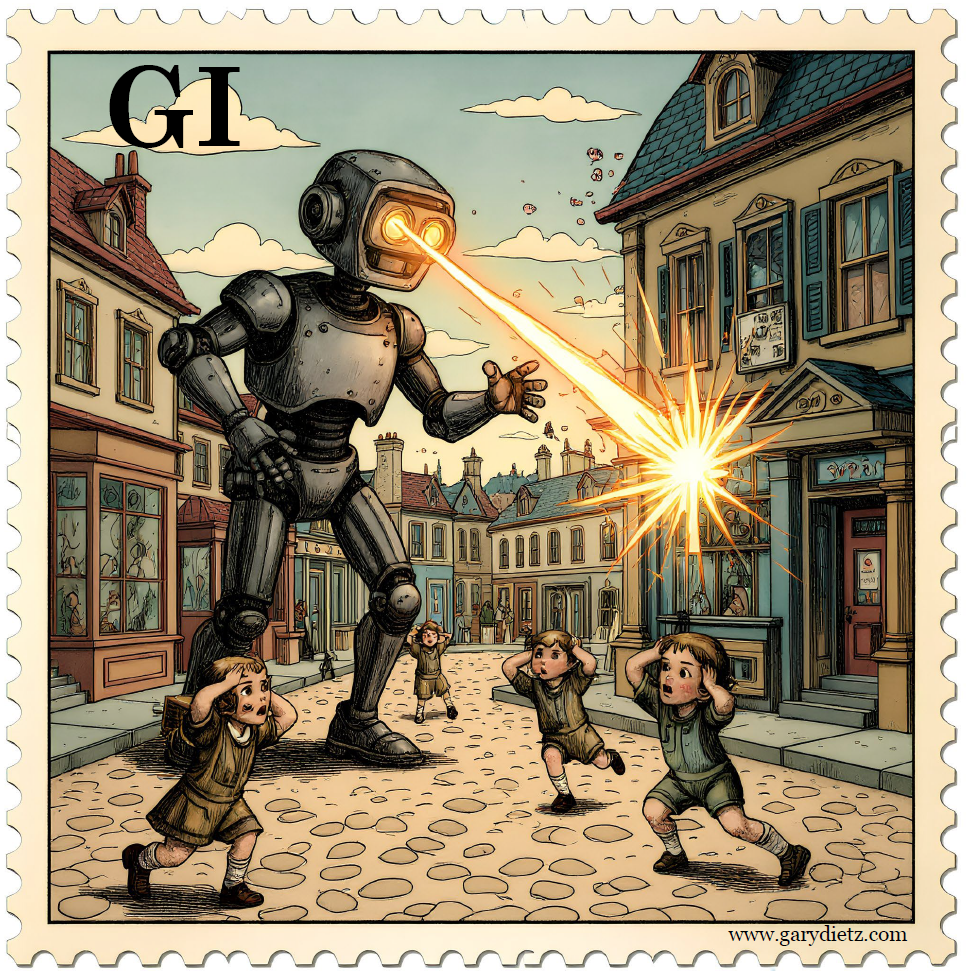
Image from Gary’s book, “From AI to ZI: A Semi-Serious Alphabet Book for Techies.”
Leave a Reply