Or, “Here’s the story, of a man named Stefan, who has shown us all some pretty funny flicks!”
Today, Stefan Gladbach (the artist formerly known as Grinds) presented “Storytelling Like a G” at Eve Horne’s PMM Jam. (FWIW, I am also a G, duh!)
But before we start, a game.
Three fibs and no truths
- Stefan has fewer wigs than Gary.
- Gary has more kids than Stefan.
- Stefan is 7 inches taller than Gary.
Go ahead, guess.
What Stefan covered (and what I’m not covering)
Stefan opened by naming the angst of the modern PMM: Layoffs, more features shipping than ever, and an AI-fueled cycle that morphs creative creators creating business influencing strategies, programs, and assets into people who push buttons and create slides with graphs.
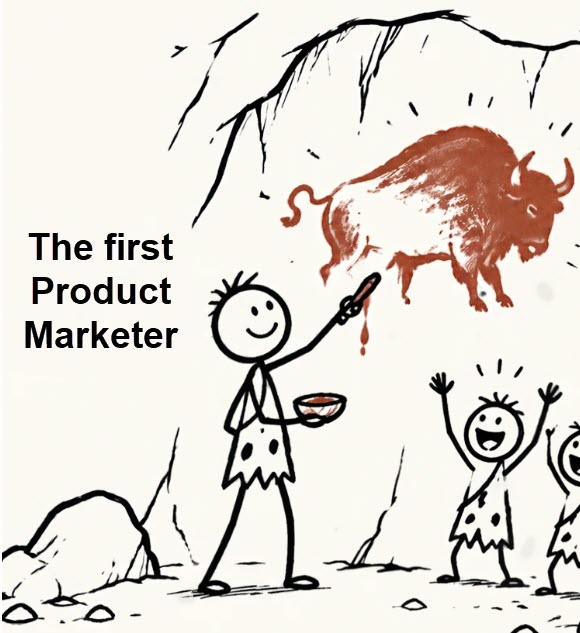
He argued that cave painters were the first product marketers. Think Neanderthal legal teams and bison blood color hue guidelines (BMYK = Bison Meat Yellow and Key). He then walked through six storytelling “moves,” each with an example from his consulting or full-time work.
He closed on creativity as a muscle, stealing structures from great stories, and getting bold ideas past stakeholders. I’m not covering it all here. Join the PMM Jam to see the recording.
My take of Stefan’s main thesis in one line:
“Inspire you to not let the AI hysteria win, don’t neglect the art for the science.”
My take in one line:
“Be bold at work. And if work won’t let you be bold, be bold in a side gig and look for work that will let you be bold. Because bold builds pipeline.”
(OK, OK… That was three lines.)
The uncanny connection
In my PMM Jam kickoff post almost two weeks ago (that’s 14 in dog weeks), I named four improv skills that make good PMMs: Trusting your scene partners, “Yes and…”, thinking on your feet, and “the pause.” Stefan’s closing challenge contained the element “take some kind of improv class.”
He didn’t push that hard enough.
Is this great minds think alike? Or everybody knows this? Or that Seattle dude Grinds ripping off the New Hampshire PMM Detective? Let’s dive in a bit see how his six “moves” closely map to or are in the same zip code as some improv essentials.
- A good story never ends → To me, this is “the callback” In improv, a callback is a statement that refers back to one told earlier. Stefan’s example is his #FreeGrinds saga and persona is a lengthy callback executed on LinkedIn.
- Write for the 200, not the 20,000 → To me, this means play to the top of your intelligence, or your niche. Del Close, godfather of long-form improv, taught performers to treat the audience like poets and geniuses. Stefan’s niche “JP” joke assumed his micro, targeted audience was in on the joke and would get it. And they did.
- Make them need the answer → To me, this implies “heightening” Improv teachers describe three levers for heightening: specifics, emotion, and stakes. Stefan’s video with the “nightmare” example pulls all three (“Oh, it gets worse”).
- Put a boring problem in the wrong genre → To me, this is “Base reality plus the first unusual thing” UCB-style training has players establish an ordinary world so anything unusual clearly stands out against it. “In all of marketing, juxtaposition is your friend,” says Stefan. For me, this is his strongest parallel to improv: The surprise and delight and greater likelihood of remembering something when the audience gets the juxtaposition.
- Let your heroes be wrong → To me, this as a form of “There are no mistakes, only opportunities” This is rule #4 of improv in Tina Fey’s book “Bossypants” which she calls her “best rule.”
Also, anti-heroes, heroes that make mistakes, have big flaws, or are a downright evil “lead character” are interesting and memorable.
- The cannoli moment → To me, this is a restatement of “the button” in improv A button is a final beat that closes out a scene. Colin Majack’s wink was a button because it wrapped up the scene and connects the audience to the main emotion of the entire piece and helps people retain the message.
Improv doesn’t have to mean funny
Good improv teachers teach that being funny shouldn’t be the improviser’s main focus, and a truthful serious scene beats forced comedy. Improv means listening, supporting your scene partner, and thinking on your feet. Those are PMM skills whether you ever make anyone laugh or not.
The big one: why leadership kills the giant taco (Remember Zach Messler’s Session? )
Stefan’s said, “Literally the riskiest thing you can do in marketing is copying or looking exactly like your competitor.” Preach it, brother.
But too many leadership teams don’t get it. I have some ideas as to why, but that must wait for another day. It is both a big topic and one that could possibly cause me to get sued for libel. I can’t be bold there, without a lawyer and or a winning lottery ticket as insurance.
Stefan was gentler in his perspective than I am on this point. What a grumpy guy I am. He believes coworkers are on your side when he said “Coworkers don’t actually want to kill your ideas. They just want to manage risk.”
Check for truly stupid
Why does differentiated, bold, unexpected creativity and/or humor get rejected so often? Sometimes the idea is truly stupid. Sometimes it really isn’t safe. And sometimes leaders don’t trust the humanity or the intelligence of the target audience. (Sorry about that, Del Close, we are talking about business leaders who just know you have to be serious to be a business leader!)
Culture and Localization is not translation
I once worked with Tom Fishburne, the Marketoonist, on a cartoon brief where his draft featured a tumbleweed. His draft connected my coffee with my keyboard through my nose.
In the executive review round, two very smart leaders, neither of them native English speakers, didn’t get the tumbleweed joke. I explained it. They stared. I said it works in American English. They stared. They killed it. I advocated. Probably a step too far. OK, definitely a step too far. They killed it anyway, and I didn’t earn any credibility. Despite the fact that the cartoon would have been shared around the US in socials with our brand smooshed all over it.
Another time, I used very relevant (and, as I recall, quite witty) sarcasm in a draft of a written piece. And an executive called me the “R” word in an email about that piece. (Yeah, that was fun… I was overseas at the time with my direct manager and almost resigned on the spot and flew home. But didn’t.)
Localization is not translation. If you aren’t a localization geek, look that one up to understand the differences. The differences are especially important when you go bold. Or go funny.
You can lose your job / credibility over this stuff. Failure here isn’t the good kind of “fail fast.” So, make sure you know:
- Who your stakeholders are, and who your champions are.
- Who owns the corporate brand, and what their personality type is.
- How many lawyers are involved.
- Whether this is the company for you, or whether you build your muscles on a side gig while you bide time trying to impact Mr. or Ms. Boring Brand.
- Language, culture, and personality of internal stakeholders who will review and approve.
This is not easy stuff. And in the wrong place or time, not for the faint of heart. Test. Ask opinions. Make guesses as to what will fly and won’t. You have judgement, use it. Pray a little. Take some risks. Or not. The choice is yours.
Of course, there are also always times when you should NOT try to be bold and others’ feedback to “kill it” are the right call and you are in the wrong. Sigh. Such is life.
Generational excuses are Sus. Bogus. Plastic. A bummer. Jive. (Usually)
Don’t assume this Boomer vs. Gen X vs. Millennial vs. Gen Z crap predicts who will respond in what way to bold. People are different even within a generation. A region. A culture.
Run multiple narratives. Perhaps the way GEICO has, using the cavemen for one target, the gecko for everyone, and testimonials for older audiences. Run a limited creative campaign as a test inside a staid corporate program.
Follow Stefan’s advice: Show your internal teams how much you look like competitors, then tease, pre-share, and find champions who will help you show that their sameness will win your argument for different and/or bold.
Closing directives for today on this topic
- Take improv.
- Know your internal mojo. Either be prepared to take career risk, or build a longer-term plan for buy-in.
- Build your creativity muscle in side gigs.
- Spend time away from AI. Build your own neurons (your own LLM, in this context).
Today’s Topic Pounds on the this PMM Jam theme!
PMM core skills haven’t really changed. Can you be a writer? A teacher? A convincer? Can you change on a dime? Can you read your audience and play to them, in other words, support your scene partner? Can you fail fast and move on? Do you know how to use the pause? Can you develop a strategy that recognizes that there are humans on the other end of a program and an asset?
None of this stuff is built with AI. AI may support it after you have the skills. But without the skills, AI isn’t gonna make you excellent.
Is this blog or Stefan’s approach a load of poppycock? Or brilliance? Or somewhere in between?
How will YOU be bold and creative as a PMM? In your own way? How will you work out your creative muscle? How will you not let AI get in the way of why you wanted to do this job in the first place?
Join the PMM Jam at www.pmmjam.com.
See you tomorrow for the finale.
GaryD
Leave a Reply