The other night, I realized a commonality across my Improv class work, my Toastmaster club activities, and communicating with my son who has intellectual disabilities. I will try to better apply this epiphany to my professional life:
A well placed and conscious verbal pause helps improve communication.
Yet, most people fear the pause.
It’s as if time spent not uttering words is seen as a negative. In public speaking, that’s one reason we use filler words like “ah” and “um” and “so.” In improv (and acting in general) experienced players use the pause to drive home so many points, be they comedic or dramatic. In communicating with children and with individuals with language processing challenges, the pause can (and in many cases must) be used to allow processing time for the listener, else communication is reduced or impossible.
After this epiphany, I sat down and tried to list some of the the ways I use, or try to use, the pause. I actually wove some of these into my last Toastmaster’s meeting (during which it was my turn to have the Toastmaster role.)
Use #1: Emphasize a physical gesture or movement
A good talk or presentation or conversation is vastly improved by the pause. Did Star Trek‘s Mr. Spock fill up the soundtrack with yakking when he raised his eyebrow? Nope. He usually accompanied it by a pause, and along with that famous raised eyebrow and uttered “odd,” or “curious,” or “unusual,” or “fascinating.” Sure, there was a short phrase, but Leonard Nimoy’s pause before the phrase told us so much.
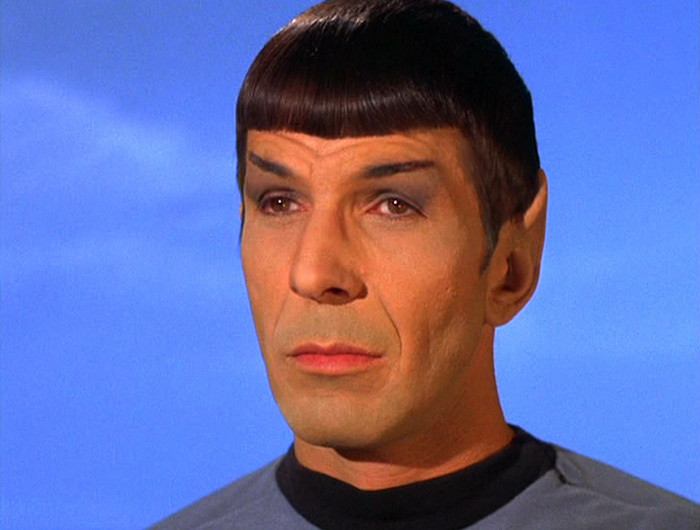
In improv, and acting in general, it is only with comfort and experience that one can just stand there and say nothing, and yet say so much. In public speaking, we don’t always need to be so funny or dramatic. But when we do, that fraction of a second to multi-second pause can often make a point louder than words. Or combined with physicality can really knock your point out of the park.
Pause Use #2: Show shock or disappointment
The very first year I was a camp counselor at the Fresh Air Fund, I talked an awful lot in front of my young charges. But I was more effective as a teacher and camp counselor when I was taught not to.
I remember one afternoon in particular I walked into our cabin and the boys were up to no good. At that point, I closed the door hard (it wasn’t a slam.) And said (with long, dramatic pauses) “What. The. Heck. Is. Going. On.” I didn’t even raise my voice. Because I used fewer words and had this dramatic door-close plus reprimand-punctuated-with-pause I had a powerful reaction.
Please don’t ask me how situations like this went before I was taught this technique!
Pause Use #3: Effect emotion
In a presentation when you want to get an emotional response, your story and your images usually are the first things you focus on. And fuss over. But don’t forget the pause.
The pause can really drive home a point by being the creator or the magnifier of emotion. For example, imagine telling an story about receiving a challenging medical diagnosis with your family in your doctor’s office. You want to make the point about how you immediately understood the doctor, but the other family members didn’t understand as quickly. Which of the following approaches could be more effective?
“The doctor quietly said ‘Cancer.’ It registered with me immediately because I’d been there before. But my sister and brother-in-law, well, that was a different story. After what felt like an eternity, I saw it. Their faces seemed to simultaneously lose muscle tone, then she collapsed in his arms.
Compare that with:
“The doctor quietly said ‘Cancer’ […long pause…] It registered with me immediately because I’d been there before. But my sister and brother-in-law [pause] Well, that was a different story. After what felt like an eternity, I saw it […long pause…] Their faces seemed to simultaneously lose muscle tone [pause] then she collapsed in his arms.
Of course in storytelling your pitch, volume, facial expressions, eye contact and many other factors impact the story. But the pause has a great impact, not just on the audience, but on you as well.
Pause Use #4: Buy a moment of reflection for you… And for your audience
The pause can give you time to think. What was I planning on saying next? Will it fly based on where the audience’s understanding now appears to be? Where is the audience emotionally? Do I need to scan their eyes? Do I need to listen to their level of attention? Do I just need a breath because I am nervous? These are only some of the reasons that you may need the pause during a talk.
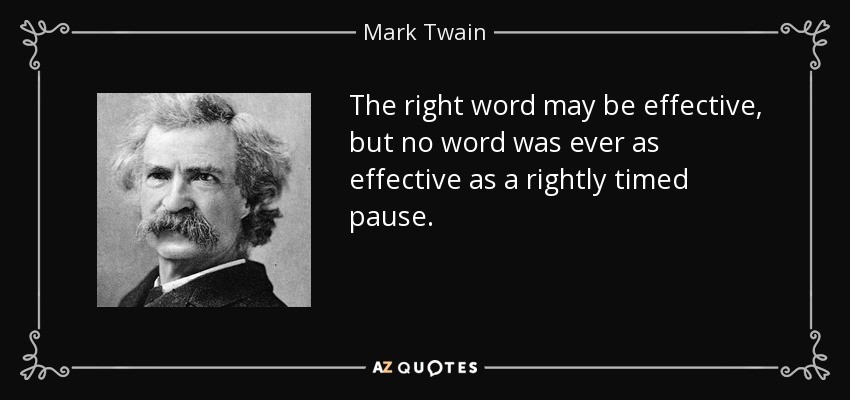
The audience also needs the pause. Give them time to drink in a point. To reflect on what you said. To see your emotion and read you. To “get” a point that may have been complex and needed some processed time. Or to “get” a joke. We’ve all heard great comedians telling an amazingly funny segment and then we hear, and possibly experience ourselves, a very delayed laugh because we needed that pause to process their humor.
If it’s good enough for art, for music, for design—well, then it’s good enough for your verbal communication
- Music? Most of us have heard that the “rest” (the “pause” of music) is what makes music live.
- Art? What we don’t see is often as important as what we were explicitly shown.
- Layout and design? White space. The empty enhances what isn’t empty.

And so it goes with your speeches. Your presentations. Your comedy and drama (if you are involved in those). Your communication with children and adults, especially those with language processing challenges.
And you?
This is by no means a complete list of the purposes of the spoken pause. Please share your insights. Thanks!